The internet has a strange way of turning a single photograph into a mystery.
One image appears online. People remember seeing it years ago. Someone adds a dramatic caption. Then the questions begin:
Who is she? What happened to her? And what does she look like today?
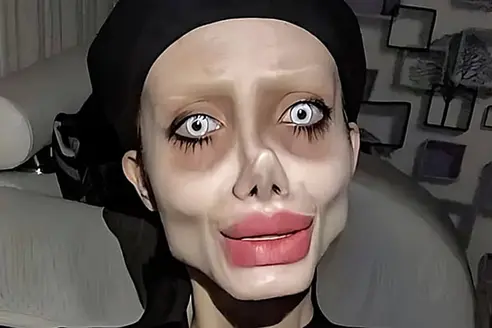
The woman in the photograph above has become the subject of exactly that kind of curiosity. Her unusually dramatic appearance immediately grabs attention, and the headline makes the viewer wonder whether there is a surprising story hiding behind the image.
But before jumping to conclusions, there’s an important detail to remember: a photograph alone doesn’t tell us someone’s medical history, identity, or what happened to them afterward.
Why Does Her Appearance Look So Unusual?
The image shows a woman with extremely pale makeup, prominent eyes, dark eye makeup, and exaggerated facial features.
Those details can completely change the way a person’s face appears.
Makeup, lighting, camera processing, contact lenses, facial expressions, and image editing can all create an appearance that looks dramatically different from an ordinary photograph.
In particular, very pale foundation combined with dark eye makeup creates an intense contrast around the eyes and mouth.
The result is striking—and easy to interpret as something mysterious.
The Internet Loves a Before-and-After Story
There’s a reason headlines such as “Do You Remember Her?” attract so much attention.
They create a gap in the story.
The reader sees a photograph but doesn’t know the ending.
That immediately creates curiosity.
What happened next?
Did she change her appearance?
Did she become famous?
Did she stop appearing online?
Was the original photograph even what people claimed it was?
Without reliable information, however, a dramatic caption can easily become separated from the original context.
A Photograph Isn’t a Biography
This is especially important when an image involves a real person.
It’s tempting to look at someone’s appearance and invent an explanation.
But appearance alone cannot tell us whether someone has a particular medical condition, what procedures they may have had, or what their personal history is.
Those are things that require reliable information from the person themselves or trustworthy documentation.
A viral photograph shouldn’t be treated as proof.
Why Old Internet Photos Keep Coming Back
Images can survive online for years.
A photograph might originally appear on a website, forum, social-media account, or news story.
Years later, someone downloads it and reposts it with a completely different caption.
Eventually, people encounter the same image without knowing where it originally came from.
The story attached to it can change every time it’s reposted.
That’s how an ordinary photograph can become an “internet mystery.”
The Power of Makeup and Lighting
The photograph also demonstrates just how much appearance can change through styling.
Professional makeup can dramatically alter:
- Skin tone
- Eye contrast
- Facial contours
- Lip shape
- Apparent eye size
- Shadows around the face
Lighting can exaggerate those effects even further.
A bright light pointed directly at the face can eliminate many natural shadows, while dark surroundings make the face appear even more prominent.
The camera can then freeze one particular expression and make it seem permanent.
Why the Eyes Stand Out
The eyes are probably the first feature most viewers notice.
The combination of pale surroundings, dark lashes, and unusually light-looking irises creates a very strong visual contrast.
This is one reason the photograph feels almost surreal.
But unusual-looking eyes in a photograph don’t automatically indicate something supernatural or medically unusual.
Camera exposure, lighting, contact lenses, image editing, and other photographic factors can all affect how eyes appear.
What About “Today”?
The headline asks viewers to imagine what the woman looks like today.
That’s a powerful storytelling technique—but it raises another question:
Do we actually know what happened after this photograph was taken?
Unless there is reliable information connecting the original photograph to a later photograph of the same person, there’s no reason to assume that a later image circulating online is genuinely the same individual.
Internet “before and after” stories are often repeated without verification.
The Mystery May Be Simpler Than It Looks
Sometimes the most interesting explanation isn’t mysterious at all.
The photograph may simply show someone using an unusual makeup style, photographed under dramatic lighting, at a particular moment.
That doesn’t make the image boring.
Quite the opposite.
It shows how dramatically photography and styling can influence what we think we’re seeing.
Why People Keep Sharing Images Like This
Mystery headlines work because they encourage people to participate.
The viewer wants to solve the puzzle.
Comments fill with theories.
People tag friends.
Someone claims to know the backstory.
Another person posts a supposed “updated” photograph.
Before long, the original context can disappear completely.
What remains is the mystery.
Don’t Believe Every “You Won’t Believe What Happened” Caption
A dramatic headline can be entertaining, but it isn’t evidence.
When an image makes an extraordinary claim, it’s worth asking:
- Where did the original photograph come from?
- When was it taken?
- Who originally published it?
- Is the person actually identified?
- Is there reliable evidence for the story?
- Are later photographs genuinely of the same person?
Those questions can turn an internet rumor into a much more interesting investigation.
Final Thoughts
The woman in this photograph certainly has a memorable appearance, and that’s probably why the image continues to attract attention.
But the most responsible conclusion is also the simplest:
We shouldn’t invent a personal or medical story from someone’s appearance alone.
What we can say is that makeup, lighting, styling, and photography can dramatically transform the way a face looks—and a mysterious caption can make an ordinary photograph feel like an unsolved story.
Sometimes the biggest mystery isn’t what happened to the person.