At first, nobody in the village understood what they were looking at.
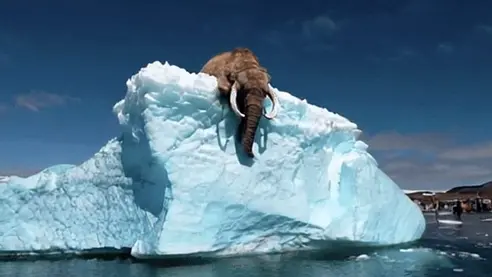
Out beyond the shoreline, an enormous iceberg had drifted into view. Its bright blue surface rose above the water like a frozen mountain, catching the sunlight against a deep blue sky.
Then someone noticed something sitting on top.
It looked impossible.
An elephant appeared to be standing on the iceberg.
Within minutes, people were gathering along the shore. Some pointed toward the strange shape. Others reached for their phones. A few simply stood frozen, trying to make sense of what they were seeing.
The photograph looks like something from a wildlife documentary—or the opening scene of a disaster movie.
But there’s a much more interesting story hiding behind an image like this.
An Elephant on an Iceberg?
Let’s start with the obvious question.
Could an elephant really be standing on an iceberg like this?
In a natural setting, the scene shown in the photograph would be extraordinarily implausible.
Elephants are terrestrial animals. They are not adapted to living on floating sea ice, and they are not native to polar environments where large icebergs occur.
The image should therefore be treated as a dramatic visual concept rather than evidence that an elephant actually climbed onto a drifting iceberg.
That’s part of what makes the picture so striking.
It combines two worlds that normally never meet.
Why Does the Image Look So Convincing?
Modern digital image creation and editing can produce scenes that look remarkably realistic.
An iceberg provides the perfect background for visual manipulation. Its irregular shapes, shadows, cracks and blue tones can make it difficult to immediately determine where reality ends and editing begins.
The elephant also appears visually convincing at first glance.
Its body, tusks and trunk create the familiar silhouette people recognize instantly. When that familiar animal is placed into an extraordinary environment, the brain can momentarily accept the scene before the logical questions arrive.
How did it get there?
Why would it be there?
How could it survive?
Those questions are exactly what make images like this so effective online.
Imagine If It Really Happened
If an elephant somehow appeared on an iceberg near a populated coastal area, residents would have much bigger concerns than simply taking photographs.
An elephant is an enormous animal that requires food, fresh water, stable ground and an environment suitable for its physical needs.
An iceberg offers none of those things.
Even if the animal somehow reached the ice, its weight could create dangerous conditions. Icebergs can contain cracks and unstable sections that aren’t obvious from the surface.
And there’s another problem:
Icebergs move.
They drift with ocean currents, wind and other environmental forces.
A large animal stranded on one would be in an extremely dangerous situation.
Why Would Everyone “Turn Pale”?
The headline uses a classic storytelling technique.
The villagers don’t immediately know what they’re seeing. Their reaction creates suspense before the explanation arrives.
Imagine seeing something enormous and completely unexpected offshore.
Your first reaction might not even be fear.
It might be confusion.
You might wonder whether you’re looking at a boat, an unusual rock formation, another iceberg or an animal.
Only after looking through binoculars—or zooming in with a phone camera—would the strange shape become recognizable.
That’s how a simple sighting could turn into a story that everyone in the village remembers.
The Iceberg Itself Is the Real Mystery
Even without an elephant, an iceberg floating close to a village can be an impressive sight.
Only a portion of an iceberg is visible above the water. A much larger volume remains submerged.
That hidden underwater section is one reason icebergs can be dangerous to boats.
Their visible shape can also be misleading.
An iceberg may appear stable from a distance while its underwater structure is changing. As ice melts, fractures develop and pieces can break away.
Sometimes a large section can suddenly fall or the iceberg can rotate.
This process is known as iceberg calving or overturning, depending on what happens.
For people living near cold-water coastlines, an unusually large iceberg drifting nearby can therefore be something worth watching carefully.
Why Are Icebergs Blue?
There’s another fascinating detail in photographs like this: the intense blue color of the ice.
Fresh snow usually looks white because it scatters visible light in many directions.
Dense glacial ice behaves differently.
As light travels through thick ice, longer wavelengths such as red are absorbed more strongly. More blue light can remain visible, giving dense ice a striking blue appearance.
That means the incredible color of the iceberg isn’t necessarily a sign of digital editing.
Nature can produce some remarkably vivid colors on its own.
Could an Elephant Survive the Cold?
Not for long under polar conditions.
Elephants evolved in warm environments and have physical adaptations suited to those climates. Their large ears, for example, help with heat management.
Extreme cold presents a completely different challenge.
An elephant stranded on sea ice would have to deal with cold temperatures, wind, lack of food and lack of suitable drinking water.
Even elephants living in colder regions require appropriate shelter and access to food and water.
So while the photograph makes for an incredible story, the real-world version would quickly become an animal welfare emergency.
The Danger of Believing Every Viral Photograph
This is where the image becomes a useful reminder about the internet.
A photograph can look convincing without being documentary evidence.
Images can be:
- Digitally edited
- AI-generated
- Created as artwork
- Cropped to remove important context
- Taken from an unrelated event
- Combined from multiple photographs
- Shared with a completely false caption
The more unbelievable the scene, the more important context becomes.
A dramatic caption such as “Residents turned pale when they saw this” can make an image feel like breaking news.
But a caption isn’t evidence.
What Would Prove the Story?
If an elephant really appeared on an iceberg near a village, there would likely be much more evidence than one photograph.
You would expect multiple photographs or videos from different angles.
There might be reports from local authorities, wildlife organizations, journalists or residents.
Satellite imagery could potentially help establish the location of an unusual iceberg.
And most importantly, there would need to be a credible explanation for how an elephant ended up there in the first place.
Extraordinary scenes require more than one mysterious photograph.
The Image May Be Fictional—But The Question Is Fascinating
Even if the scene isn’t real, it creates an interesting thought experiment.
What would happen if an animal from a tropical environment suddenly found itself in an Arctic landscape?
The answer reveals just how specialized wildlife can be.
Animals aren’t simply interchangeable creatures that can live anywhere. Their bodies, behavior, diets and survival strategies have evolved around specific environments.
An elephant belongs on land.
An iceberg belongs in cold waters.
Put the two together, and the result is an image that looks almost like a surreal dream.
The Real Lesson Behind the Viral Scene
The next time you see a photograph that makes you stop scrolling, don’t immediately ask, “Is this incredible?”
Ask:
“What evidence shows that this actually happened?”
That single question can change the way you consume viral content.
The internet is filled with breathtaking photographs, strange wildlife encounters and unbelievable discoveries. Some are genuine. Others are carefully edited or completely artificial.
The image of an elephant standing on an iceberg is a perfect example of why visual evidence needs context.
It may look like something that left an entire village speechless.
But sometimes the most surprising part of a viral photograph isn’t what happened in front of the camera.