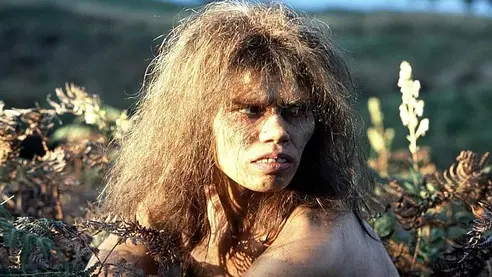
At first glance, there is nothing obviously unusual about her.
She has a familiar face. Two eyes. A nose. A mouth. Hair. Hands. A posture that looks remarkably human.
If you saw her briefly in a photograph, you might never question what you were looking at.
But according to the story surrounding this mysterious case, scientists became interested after noticing details that didn’t seem to fit. What began as an unusual observation eventually turned into a much bigger question:
What exactly was she?
The most dramatic part of the story came when DNA testing was reportedly brought into the investigation.
And that’s when everything became even more confusing.
The First Look Raised Questions
The strange case supposedly began with photographs that circulated online.
At first, people reacted to the images in predictable ways. Some believed they were looking at an ordinary person photographed from an unusual angle. Others thought the appearance might have been created through editing, artificial intelligence, makeup, or special effects.
But the more closely people examined the images, the more questions appeared.
There seemed to be something unusual about the subject’s physical characteristics.
Her appearance was familiar enough to look human, yet unusual enough to make people wonder whether there was another explanation.
Of course, appearance alone cannot determine someone’s biological identity.
Humans naturally vary enormously in facial features, body proportions, skin characteristics, and other physical traits. An unusual appearance is not evidence that someone belongs to another species.
That distinction becomes particularly important when viral photographs are involved.
Then Came The DNA Claim
The headline became much more dramatic when the story claimed that DNA testing had produced an unexpected result.
According to the viral version of the story, the genetic evidence didn’t fit what observers expected.
But there’s an important problem.
DNA doesn’t simply produce a result saying “human” or “not human.”
Genetic testing is much more complicated than that.
Scientists use different types of DNA analysis for different purposes. A test might examine specific genetic markers, compare sequences between individuals, identify biological relationships, or determine whether a sample belongs to a particular species.
A genuine scientific investigation would therefore require information about the sample, testing method, laboratory procedures, reference genomes, and results.
Without those details, a dramatic claim about mysterious DNA should be treated cautiously.
Why DNA Is So Powerful
DNA contains biological information inherited from an organism’s parents.
In humans, nearly every cell containing a nucleus carries DNA. Scientists can examine portions of that genetic material to learn an extraordinary amount about an individual.
Modern genetic techniques can help researchers study ancestry, identify biological relationships, investigate diseases, and distinguish between species.
That makes DNA one of the most useful tools in modern biology.
But it also makes the word DNA incredibly powerful in a story.
When someone says, “Scientists tested the DNA,” it can make an unverified story sound scientific—even when important details are missing.
That’s why researchers don’t stop at a sensational claim.
They ask:
What was tested?
Where was it tested?
How was it tested?
What exactly did the results show?
And perhaps most importantly:
Can another qualified laboratory reproduce the findings?
Could Something Look Human Without Being Human?
Biology provides many examples of organisms that share surprisingly similar characteristics.
Different species can evolve similar physical traits when they face similar environmental pressures. This phenomenon is known as convergent evolution.
For example, bats and birds both have wings, even though they belong to very different branches of the animal kingdom.
Whales have streamlined bodies that resemble those of fish, despite being mammals.
These similarities demonstrate something important:
Looking similar does not necessarily mean being closely related.
However, a creature that genuinely possessed an unmistakably human body and complex human-like characteristics would represent an extraordinary scientific discovery.
Such a claim would require extraordinary evidence.
Photographs wouldn’t be enough.
Neither would an anonymous DNA claim posted online.
Scientists would want physical specimens, properly documented samples, repeatable genetic analysis, anatomical examination, and independent verification.
The Internet Made The Mystery Even Bigger
Once unusual images appear online, the story can quickly take on a life of its own.
One website publishes a dramatic headline.
Another website rewrites it.
Social media users add theories.
Someone creates a video explaining what they believe happened.
Soon, the original source can become almost impossible to identify.
Details may change with every retelling.
A person described as “unusual” becomes “mysterious.”
A mysterious photograph becomes “proof.”
And eventually, an unverified claim about DNA can be presented as an established scientific fact.
This is one reason viral mystery stories are worth examining carefully.
The most interesting question isn’t always “Is this real?”
Sometimes the better question is:
“What evidence actually exists?”
The Human Brain Loves Unsolved Mysteries
There’s a psychological reason stories like this attract so much attention.
Humans are naturally drawn to things that don’t fit neatly into familiar categories.
A photograph of an ordinary person doesn’t necessarily stop someone from scrolling.
But a headline claiming that someone looks human while supposedly having unexplained DNA creates an immediate information gap.
Our brains want to close that gap.
We want an explanation.
Was there a genetic mutation?
Was the image manipulated?
Was the person misidentified?
Was the DNA sample contaminated?
Was the story completely fictional?
Or is there genuinely something scientists don’t understand?
The absence of an immediate answer is what creates the mystery.
What Would Scientists Need To Prove A Discovery Like This?
If researchers genuinely encountered an organism that appeared human but possessed fundamentally different DNA, the investigation would likely be extensive.
First, scientists would need to establish that the biological sample actually came from the subject in question.
Then they would analyze the genetic material using validated laboratory techniques.
Researchers would also need to rule out contamination.
That is particularly important because DNA is everywhere. Human DNA can easily be introduced accidentally during collection, handling, transportation, or laboratory processing.
Next would come independent testing.
A truly extraordinary discovery couldn’t reasonably depend on a single unexplained laboratory result.
Other researchers would need access to appropriate samples and sufficient information to verify the findings.
Only after repeated testing and independent confirmation would the scientific community begin considering an extraordinary biological explanation.
The Difference Between Mystery And Evidence
This is where the story becomes particularly interesting.
There is nothing wrong with being fascinated by a strange photograph.
Mystery can be entertaining.
Speculation can be fun.
But there is a major difference between saying:
“This photograph raises questions.”
and saying:
“Scientists have proven this person isn’t human.”
The first statement describes uncertainty.
The second requires evidence.
If the DNA results, laboratory records, scientific publication, or independent verification aren’t available, the extraordinary conclusion remains unproven.
That doesn’t necessarily make the photograph boring.
In fact, the uncertainty may be what makes it fascinating.
Could The Explanation Be Much Simpler?
Sometimes the answer to a mysterious image is far less dramatic than the internet suggests.
Lighting can dramatically change someone’s appearance.
Camera lenses can distort proportions.
Unusual angles can make familiar facial structures look completely different.
Image compression can remove important details.
Digital editing can alter photographs almost invisibly.
And increasingly sophisticated AI-generated images can create people and creatures that look remarkably convincing.
That means a strange-looking photograph shouldn’t automatically be treated as evidence of an unknown biological discovery.
Before reaching an extraordinary conclusion, ordinary explanations should be investigated first.
So, What Does Her DNA Really Say?
That’s the question at the heart of the entire story.
The headline claims that her DNA says something unexpected.
But a headline isn’t a laboratory report.
Unless the underlying genetic data and credible scientific documentation are available, there is no responsible way to conclude that the subject belongs to an unknown species or possesses non-human DNA.
What we can say is that unusual images can generate fascinating questions about genetics, evolution, perception, and the limits of what photographs can actually prove.
And perhaps that’s the most intriguing part of the mystery.
She may look unusual.
The story may sound extraordinary.
But when it comes to DNA, the evidence matters far more than the headline.
Because if scientists ever genuinely discovered an organism that looked unmistakably human while possessing fundamentally different genetic characteristics, it wouldn’t remain merely an internet mystery.
It would become a scientific discovery with consequences for biology, evolution, and our understanding of life itself.
Until independently verified evidence emerges, however, the mystery remains just that:
a mystery.