There are some animal encounters that seem almost impossible to believe when you first see them. A powerful lion standing inside an enclosure is already an intimidating sight. But when a tiny dog appears just a few feet away, the contrast is startling.
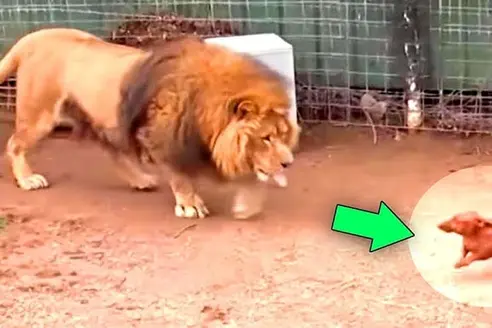
The photograph above captures a moment that immediately raises questions. A small dog appears to be inside an enclosure with a large lion, while the lion lowers its head and seems to investigate the unfamiliar animal. One simple question comes to mind:
What happens when a tiny dog finds itself face-to-face with a lion?
The image has the kind of dramatic appearance that can easily make it look like the beginning of a terrifying story. But a photograph alone cannot tell us exactly what happened before or after the moment it captured.
Still, the scene offers a fascinating look at how two very different animals might react when placed in an unusual situation.
A Meeting Nobody Would Expect
Lions are among the most recognizable predators on Earth. They are built for hunting, with powerful muscles, sharp teeth, strong jaws, and highly developed senses.
A tiny domestic dog, on the other hand, can look almost insignificant beside a fully grown lion.
That enormous difference is what makes the image so striking.
In the picture, the lion appears to be approaching the smaller animal cautiously. Rather than immediately attacking, it seems to be using its nose to investigate what is in front of it.
For anyone looking at the photograph, the lion’s behavior creates an enormous amount of suspense.
Is it curious?
Is it confused?
Is it simply trying to identify the unfamiliar animal?
Without reliable information about the circumstances surrounding the photograph, there is no way to know exactly what the lion was thinking.
And that uncertainty is part of what makes the image so fascinating.
Why Would A Lion Smell A Dog?
Smell plays an important role in how many animals understand their surroundings.
Lions have an extremely developed sense of smell, and scent can provide information about unfamiliar animals, food, territory, and other environmental changes.
When a predator encounters something it doesn’t immediately recognize, investigating through smell can be a natural part of its behavior.
The lion in the image appears to be doing exactly that.
Instead of immediately reacting dramatically, it seems to lower its head toward the smaller animal.
That doesn’t necessarily mean the lion has accepted the dog as a friend.
It simply shows why observing animal behavior can be more complicated than assuming that every predator encounter automatically results in an attack.
The Size Difference Is Incredible
Perhaps the first thing viewers notice is the difference in size.
The lion’s body dominates the enclosure, while the dog appears extremely small by comparison.
A large adult lion can weigh several times more than a typical domestic dog. It also possesses physical abilities that a small dog simply cannot match.
That makes the situation appear extremely dangerous.
But size alone doesn’t explain animal behavior.
Animals don’t always react to unfamiliar creatures in the way humans expect. Their response can depend on factors such as previous experiences, stress levels, surroundings, familiarity, and whether they perceive the other animal as a threat.
That is why experts generally caution against interpreting a single photograph as proof of what an animal is feeling or intending.
The Moment Before The Photograph Matters
Imagine watching this scene unfold in real time.
The dog enters the enclosure.
The lion notices something moving.
It turns its head.
The smaller animal remains nearby.
The lion slowly approaches.
Then comes the moment captured in the photograph: the lion appears to lower its head and smell the dog.
For a person watching from outside, every second would probably feel much longer.
Would the lion walk away?
Would the dog run?
Would the lion become aggressive?
Or would the encounter simply end with the two animals losing interest in one another?
A single image doesn’t provide those answers.
That’s an important detail to remember when photographs like this circulate online. Images can capture an extraordinary moment, but they don’t necessarily provide the full story surrounding it.
Predators Don’t Always Behave Like Movie Monsters
Movies and television have trained people to think of lions almost exclusively as aggressive hunters.
In reality, animal behavior is much more varied.
A lion spends much of its time resting, observing, communicating, moving around its environment, and interacting with other members of its group. Hunting is only one part of its behavioral repertoire.
That doesn’t make a lion safe to approach.
Quite the opposite.
A wild or captive lion remains a powerful predator capable of causing catastrophic injuries. But understanding this distinction helps explain why an unusual encounter may begin with curiosity rather than immediate aggression.
The lion’s apparent sniffing behavior in the photograph could therefore be interpreted simply as investigation.
What Makes This Picture So Unforgettable?
The photograph works because of contrast.
On one side is a massive predator.
On the other is a tiny dog.
Between them is a moment of uncertainty.
The bright arrow pointing toward the smaller animal makes the viewer’s eyes immediately focus on the dog. Once you notice it, the lion’s size becomes even more dramatic.
The composition almost feels like a scene from a wildlife documentary.
But unlike a carefully narrated documentary, the image doesn’t tell us everything.
There’s no explanation of what happened seconds earlier.
There’s no guarantee about what happened afterward.
And there is no confirmed context contained within the photograph itself.
That leaves viewers filling in the missing pieces with their imagination.
A Reminder About Viral Animal Photos
Images involving unusual animal encounters often spread rapidly online because they trigger an immediate emotional response.
A photograph of a lion and a tiny dog naturally makes people curious.
But viral captions can sometimes become more dramatic as an image is shared from one page to another. Details can be added, removed, or changed, while the original context becomes difficult to trace.
That’s why it’s useful to separate what the photograph visibly shows from what someone claims happened.
The image appears to show a lion investigating a small dog inside an enclosure.
Anything beyond that—such as why the dog was there, what happened afterward, or whether the encounter was staged or part of a controlled animal setting—would require reliable information from the original source.
The Lion’s Reaction Is The Real Mystery
Perhaps the most interesting part of the photograph isn’t the dog’s presence at all.
It’s the lion’s reaction.
The lion doesn’t appear to be charging in the captured moment. Instead, its attention is focused on the smaller animal.
That creates an intriguing reminder about the complexity of animal behavior.
When humans see a large predator next to a tiny animal, we immediately imagine the worst possible outcome. But animals don’t necessarily follow the dramatic script that our brains create for them.
Sometimes the most interesting wildlife moments are the quiet ones—the moments when an animal stops, observes, smells, and decides what to do next.
Never Try To Recreate An Encounter Like This
Although the photograph may look fascinating, it should never be treated as an example of something people can safely recreate.
Domestic dogs and large predators should not be deliberately placed together.
Even if a lion appears calm, its behavior can change extremely quickly. A playful movement, defensive reaction, territorial response, or sudden startle could result in serious injury or death.
Wildlife professionals use controlled environments, barriers, specialized equipment, and carefully designed procedures when working around large predators.
For ordinary visitors, the safest way to experience animals like lions is from an appropriate distance and behind proper protective barriers.
One Photograph, Hundreds Of Questions
The tiny dog and the enormous lion create an image that is difficult to forget.
The lion appears to lean toward the smaller animal.
The dog is almost completely overshadowed by its much larger companion.
And the simple act of the lion appearing to smell the dog turns what could have been a frightening scene into a moment filled with uncertainty.
What happened next?
Did the lion lose interest?
Did the dog move away?
Was the encounter part of a controlled environment?
Those questions cannot be answered from the photograph alone.
And perhaps that’s exactly why the image continues to capture attention.
Sometimes a single picture doesn’t give us the entire story.
It gives us just enough to make us want to know what happened next.