The ranger had seen plenty of strange things in the wilderness.
Broken branches.
Abandoned nests.
Animal tracks.
Even evidence of predators passing through areas where visitors rarely ventured.
But what he discovered in this tree made him stop in his tracks.
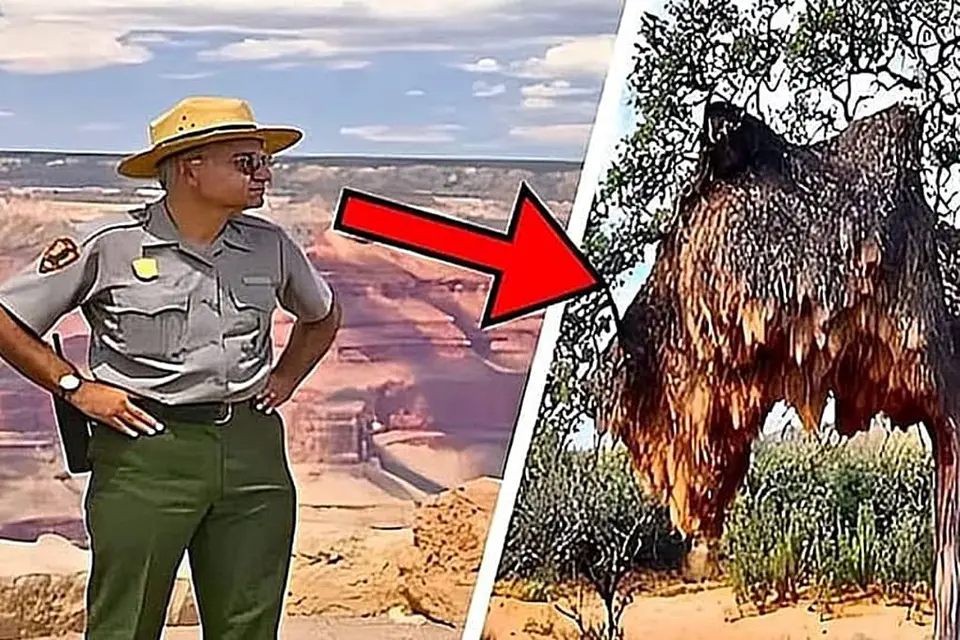
High above the ground was an enormous, tangled structure that looked nothing like an ordinary bird’s nest.
It was large, dark and covered with what appeared to be thick strands of hair or vegetation.
The ranger stared at it for several seconds.
Then he made a decision.
People needed to stay away from the area.
The photograph makes the discovery look even more mysterious.
But what could possibly make a park ranger close off part of a wilderness area?
It Didn’t Look Like an Ordinary Nest
Most people picture a bird’s nest as a relatively small structure made from twigs, grass, leaves and other natural materials.
The object in the photograph looks dramatically different.
It appears large enough to attract attention from a considerable distance, with long strands hanging down from the structure.
That immediately raises an important question:
What kind of animal could build something like this?
The answer isn’t necessarily as frightening as the photograph makes it appear.
Wild animals can create surprisingly large structures.
Some use branches, leaves and vegetation to build shelters. Others modify existing cavities, rock formations or trees.
And sometimes what looks like a carefully constructed nest may actually be a combination of natural materials gathered over time.
Why Would a Ranger Evacuate an Area?
The word “evacuate” makes the story sound like an emergency.
But in a real park, temporarily closing an area doesn’t necessarily mean that something catastrophic has happened.
Rangers routinely restrict access when they discover potential hazards.
These can include:
- Aggressive wildlife
- Unstable trees
- Falling rocks
- Wildfires
- Flooding
- Dangerous terrain
- Wasps or bees
- Predator activity
- Damaged trails
- Other environmental hazards
A temporary closure can therefore be a simple precaution.
If an unusual animal structure is located near a popular trail, keeping visitors away while specialists investigate can be the responsible thing to do.
The Hair-Like Material Is the Biggest Clue
The most unusual feature in the image is the long, shaggy material covering the structure.
At first glance, it could look like animal hair.
But photographs can be deceptive.
Dry grasses, moss, hanging vines, bark fibers and other vegetation can appear surprisingly similar to fur—especially when viewed from a distance or under unusual lighting.
Even a pile of natural debris can take on an animal-like appearance.
This is one reason wildlife identification should not be based on a single dramatic photograph.
Could It Belong to a Giant Animal?
That’s where the imagination starts running wild.
An enormous nest immediately makes people think of an enormous creature.
Perhaps there is a giant animal hiding nearby.
Perhaps the structure belongs to something rarely seen.
Perhaps the ranger discovered something that nobody was supposed to find.
Those possibilities make a fantastic story.
But there’s an important distinction between something looking unusual and evidence of an unknown creature.
The photograph by itself doesn’t establish that a giant or unknown animal created the structure.
Wildlife Can Be Much More Creative Than We Expect
Animals frequently manipulate their surroundings.
Birds collect twigs and leaves.
Beavers reshape waterways.
Squirrels construct nests from vegetation.
Primates sometimes build sleeping platforms.
Even relatively small animals can create structures that look surprisingly substantial when viewed up close.
In nature, size doesn’t always tell you how long something took to build.
A structure can accumulate gradually as an animal repeatedly returns to the same location.
Why Would Visitors Need To Stay Away?
Imagine discovering a strange structure near a hiking trail.
You don’t know what’s inside.
You don’t know whether an animal is currently using it.
You don’t know whether there are young animals nearby.
And you don’t know how the animal might react if someone approaches.
The safest response isn’t to investigate personally.
It’s to create distance.
Wild animals can become defensive when people approach their shelters, nests or offspring.
Even animals that normally avoid humans can react unpredictably when they feel threatened.
That’s one reason wildlife professionals emphasize observing animals from a safe distance.
A Camera Zoom Doesn’t Tell the Whole Story
The image uses a large arrow to direct attention toward the mysterious structure.
That’s a common technique in viral wildlife content.
The arrow essentially tells the viewer:
“Look at this.”
Once your attention is focused there, your brain starts searching for an explanation.
Is that fur?
Is something hiding inside?
Is there an animal behind the tree?
Could the structure be enormous?
The more questions you ask, the more mysterious the photograph becomes.
But the arrow itself doesn’t provide additional evidence.
What Would Rangers Actually Look For?
If professionals discovered an unusual animal structure, they could examine the surrounding area for clues.
They might look for:
Tracks:
Footprints can reveal the approximate size and type of animal using an area.
Droppings:
Animal scat can sometimes provide valuable identification clues.
Hair or feathers:
Collected samples can potentially help identify a species.
Feeding signs:
Chewed vegetation, damaged bark or disturbed ground can indicate what animals have been nearby.
Camera footage:
Trail cameras can reveal which species are visiting an area when humans aren’t present.
Additional nests or shelters:
Finding similar structures nearby can help explain whether the object is unusual or part of a normal behavior pattern.
This is how wildlife mysteries are actually investigated.
Not by guessing from one photograph.
What If Something Really Dangerous Was Nearby?
A ranger’s first responsibility is public safety.
If there were evidence of a potentially dangerous animal near a heavily used trail, temporarily restricting access would make sense.
The same principle applies to a nest containing aggressive insects.
A large colony of stinging insects can be extremely dangerous if disturbed.
From a distance, a dark, tangled structure in a tree might not immediately reveal what’s inside.
Getting close just to take a better photograph could be a very bad idea.
The Internet Makes Wildlife Mysteries Bigger
A photograph can begin with a simple description:
“Ranger discovers unusual animal nest.”
After being shared repeatedly, the headline may become:
“Ranger turns pale after discovering terrifying creature.”
Then someone adds:
“The area was immediately evacuated.”
Eventually, the original context can disappear completely.
The final version may sound like a wildlife horror story.
That’s why it’s worth asking where a photograph came from before accepting the story attached to it.
Don’t Approach Strange Wildlife Structures
Regardless of what’s actually inside the structure shown in the image, there’s one lesson worth taking seriously.
If you encounter an unfamiliar animal nest, den or shelter while hiking, don’t approach it simply because you’re curious.
Don’t poke it.
Don’t climb the tree.
Don’t attempt to look inside.
And don’t encourage other people to get closer for a photograph.
Instead, move away and notify park staff if appropriate.
A few seconds of curiosity aren’t worth risking a bite, sting, fall or encounter with a defensive animal.
The Mystery May Have a Very Ordinary Explanation
The photograph certainly looks dramatic.
The ranger’s expression, the enormous red arrow and the strange-looking structure create the feeling that something extraordinary has been discovered.
But nature frequently produces things that look stranger than they really are.
A tangled mass of vegetation can resemble fur.
A normal animal shelter can look enormous from the right angle.
A harmless structure can appear threatening when paired with a dramatic caption.
And a simple precautionary trail closure can become an “evacuation” in an exaggerated retelling.
So What Was Really Inside?
That’s the question the photograph leaves hanging.
Was it an unusual nest?
A mass of vegetation?
An animal shelter?
Something created by a species that is perfectly ordinary but rarely seen?
Or simply a carefully constructed viral image designed to make viewers wonder?
Without reliable information about the original location, photographer, species and circumstances, the photograph alone can’t answer those questions.
And perhaps that’s why images like this spread so quickly.
They don’t give you the answer.
They give you just enough mystery to make you want one.
The next time you see a strange wildlife photograph with a giant arrow pointing toward something unbelievable, take a second look.
The real story might be fascinating.
But sometimes, the biggest mystery isn’t what the ranger discovered.