Trail cameras are designed to capture ordinary wildlife.
A deer walking through the woods.
A fox searching for food.
A raccoon passing by after dark.
But every once in a while, a camera captures something that looks so strange that even experienced wildlife watchers have to stop and look twice.
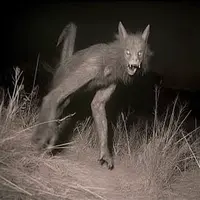
That’s exactly what happened with a photograph like this.
Taken in darkness, the image appears to show a tall, unusually thin canine standing on a trail. Its body looks almost skeletal, its ears appear pointed, and its posture gives the animal an eerie, almost unnatural appearance.
At first glance, it looks like something that shouldn’t exist.
But the real explanation may be just as fascinating.
The Photograph That Raises Questions
The first thing that catches your attention is the animal’s shape.
Its legs appear unusually long.
Its body looks extremely thin.
The ears seem larger than expected.
And because the photograph was taken at night, the limited lighting makes every feature look more dramatic.
Trail cameras can produce strange-looking images because they are designed around motion detection and infrared illumination rather than photography for perfect visual detail.
A single frame can therefore make a familiar animal look completely different.
Could It Be a Wolf?
One obvious possibility is a wild canid such as a wolf or coyote.
Both animals can appear surprisingly thin under certain conditions, particularly after seasonal changes, illness, injury, or periods when food is difficult to find.
A wolf standing at an unusual angle can also look dramatically different from the familiar images people see in wildlife documentaries.
The photograph alone isn’t enough to identify the animal with certainty.
And that’s where the mystery begins.
Why Nighttime Makes Wildlife Look Strange
Human vision is remarkably good at recognizing familiar objects in daylight.
At night, however, we lose much of the visual information our brains normally use.
Color disappears.
Shadows become more important.
Depth becomes harder to judge.
And infrared cameras can produce images with unusual contrast.
An animal that looks normal in daylight can therefore appear almost unrecognizable in a black-and-white trail-camera photograph.
The camera may also capture the animal during a single unusual movement.
A raised leg, stretched neck, or awkward body position can completely change its silhouette.
The “Monster” Effect
There is another reason photographs like this become so popular.
Our brains are constantly trying to identify patterns.
When we see something unfamiliar, we compare it with things we already know.
If an animal looks slightly different from a normal wolf, our imagination may fill in the missing details.
Suddenly, the animal becomes a mysterious creature.
Add a dark forest, a nighttime photograph, and a dramatic headline—and the ordinary explanation can seem much less interesting than the mysterious one.
What Could Make a Wild Canid Look So Thin?
There are several possibilities.
A wild animal may naturally have a lean body, particularly when food availability changes.
Other possibilities can include:
- Age
- Illness
- Injury
- Parasites
- Poor nutrition
- Seasonal changes
- Dehydration
- Natural variation between individuals
A single photograph can’t tell us which explanation applies.
That’s why wildlife experts generally need more evidence before identifying an unusual animal.
They might examine additional photographs, tracks, location information, behavior, and eventually video or physical evidence.
Trail Cameras Capture More Than People Expect
Modern trail cameras can operate for weeks or months without human attention.
They may photograph animals that people rarely see.
Some cameras are triggered hundreds of times in a single night.
Most of those images are completely ordinary.
But occasionally, the camera catches an unusual moment.
An animal may walk directly toward the lens.
Another may stand on its hind legs.
A bird can appear enormous because of its position close to the camera.
A deer can look almost prehistoric when photographed at the wrong angle.
The result can be genuinely startling.
The Importance of Scale
One of the biggest problems with mysterious wildlife photographs is the lack of scale.
How far away is the animal?
How large is the camera?
How high is the camera mounted?
Is the animal standing on uneven ground?
Without knowing those details, it’s difficult to estimate the animal’s actual size.
An animal close to the camera can appear much larger than one standing several meters farther away.
That can turn an ordinary animal into something that looks enormous.
And Then There’s the Angle
The angle of the photograph can completely change the animal’s appearance.
Imagine photographing a dog from ground level while it is stretching forward.
Its legs may appear unusually long.
Its head may appear larger.
Its body may look extremely narrow.
Now add infrared lighting and a dark background.
The result can look remarkably strange.
That’s why wildlife identification normally relies on multiple characteristics rather than one dramatic silhouette.
Does the Photograph Prove Something Unknown Is Out There?
No.
An unusual photograph can raise interesting questions, but it doesn’t by itself establish the existence of an unknown species or supernatural creature.
To make such a claim convincing, researchers would need stronger evidence.
That could include:
- Multiple independent photographs
- Clear video
- Tracks with reliable measurements
- Biological samples
- Consistent sightings
- Geographic evidence
- Eventually, physical evidence
Without that kind of information, the most responsible approach is to keep several explanations open.
Why People Love Mystery Wildlife
There’s something irresistible about seeing an animal that we can’t immediately identify.
It reminds us that large parts of the natural world can still feel mysterious.
Even in places relatively close to human communities, wildlife can move through forests, deserts, mountains, and fields without ever being seen directly.
A trail camera simply gives us a tiny window into that hidden world.
And sometimes that window produces a photograph that looks almost impossible.
The Most Interesting Possibility May Be the Simplest
The animal in a photograph like this doesn’t necessarily need to be a mysterious creature to be fascinating.
If it’s a wild wolf, coyote, or another unusual canid, that’s already an extraordinary glimpse into wildlife behavior.
The animal was moving through the landscape while almost everyone else was asleep.
The camera happened to be watching.
And for a fraction of a second, the two crossed paths.
That’s what makes trail-camera photography so compelling.
You never know what will appear in the next frame.
A Single Picture Can Tell Only Part of the Story
The photograph may look like evidence of something impossible.
But without information about its location, date, camera settings, surrounding tracks, and additional images, we can’t know exactly what we’re looking at.
And that’s perhaps the most interesting part.
The image gives us a question.
It doesn’t necessarily give us the answer.
Final Thoughts
A trail camera doesn’t care whether an animal looks ordinary or extraordinary.
It simply detects movement and captures whatever happens to pass in front of its lens.
Sometimes that’s a deer.
Sometimes it’s a fox.
And sometimes, the resulting photograph is strange enough to make thousands of people wonder what they are looking at.
This mysterious-looking animal may ultimately have a perfectly natural explanation.
But until the full story is known, one thing is certain:
There’s a lot more happening in the wild at night than most of us ever get to see.