Think you have a sharp eye for shapes and spatial reasoning? This deceptively simple cube puzzle is designed to make you look twice.
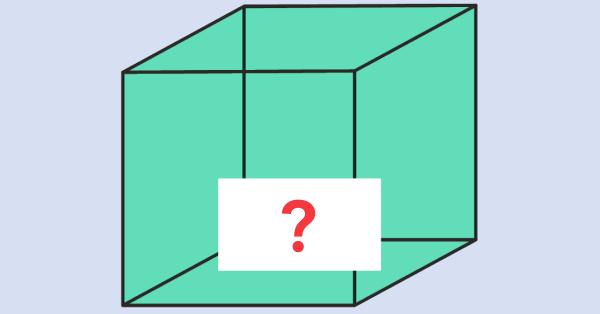
At first glance, the image appears to show an ordinary three-dimensional box. But the real challenge is to visualize the hidden structure and determine what should appear behind the question mark.
Can You Figure It Out?
Don’t rush to an answer.
Look carefully at the visible edges of the cube. Pay attention to:
- Which lines are connected
- How the faces meet at the corners
- Which edges appear to continue behind the covered area
- The difference between the front, top, and side faces
- Whether the perspective changes how you interpret the shape
The trick is that your brain naturally tries to interpret a flat image as a complete three-dimensional object. That’s where the puzzle becomes interesting.
Why Cube Puzzles Are So Tricky
Questions like this primarily challenge spatial reasoning—the ability to mentally understand objects, relationships, and positions in three-dimensional space.
You may find yourself mentally rotating the cube, imagining its hidden faces, or tracing an edge from one visible corner to another.
That’s also why these puzzles can feel surprisingly difficult even when the drawing itself looks simple.
Don’t Guess Too Quickly
Before choosing an answer, try mentally rotating the cube.
Imagine looking at it from the left.
Now imagine looking from above.
Then ask yourself: Would the hidden section still make sense from each angle?
That extra step can reveal inconsistencies that aren’t obvious when you’re only looking at the original picture.
What Does Your Result Mean?
If you solved the puzzle quickly, you may have strong visual-pattern and spatial-reasoning skills. If it took you several attempts, that’s perfectly normal too.
However, one online puzzle cannot determine whether your IQ is 130. Standardized intelligence testing involves multiple tasks and controlled scoring procedures; IQ scores are not something that can reliably be calculated from a single visual question.
An IQ of 130 has historically been used as a threshold for identifying very high ability in some contexts, but the number itself comes from standardized testing rather than a viral brain teaser.
Final Challenge
Take another look at the cube before moving on.
Can you visualize the missing part without drawing it out?
If you can, you may have a particularly good instinct for spatial puzzles.
High IQ is 130. What is yours?
Remember: this is a fun brain challenge, not a professionally administered IQ test.