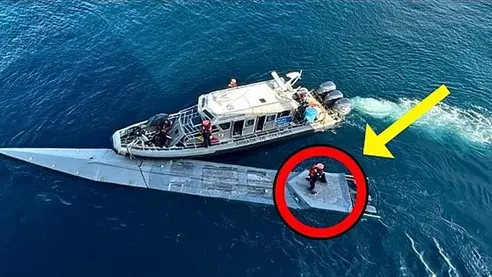
From high above, the scene looks almost impossible to understand.
A large blue vessel sits on deep, crystal-clear water. Nearby, another boat appears to be approaching it, while a person stands close to the edge of the larger vessel.
A bright yellow arrow points toward the mysterious area.
And suddenly, the obvious question becomes impossible to ignore:
What is actually happening on this boat?
The photograph has all the ingredients of a viral mystery—deep blue water, an unusual vessel, people gathered on board, and a small detail highlighted as if it contains the answer.
But there’s an important catch.
A photograph like this can show us what was visible at one particular moment. It doesn’t automatically tell us the complete story.
What Does the Image Actually Show?
The picture appears to have been taken from above, possibly from a drone or aircraft.
A large vessel can be seen floating in open water, with several people visible on or around it. Another smaller craft appears nearby.
The most attention-grabbing detail is the person or object highlighted by the red circle.
The yellow arrow directs the viewer’s attention toward it, creating the impression that something extraordinary has been discovered.
But without information about the location, vessel, date, crew and circumstances, it’s impossible to identify exactly what that highlighted area represents simply from the photograph.
And that’s what makes the image so intriguing.
Why Does the Boat Look So Strange?
From an aerial perspective, boats can look completely different from how they appear at water level.
Structures that seem mysterious from above may simply be:
- Equipment platforms
- Storage areas
- Deck machinery
- Safety equipment
- Inflatable boats
- Fishing equipment
- Access points
- Crew working areas
The ocean also creates another visual problem.
Water can hide scale.
A person who appears tiny in an aerial photograph might actually be standing on a large deck. An object that looks enormous could be much smaller than expected.
Without a known reference point, photographs can easily create misleading impressions.
The Blue Water Makes Everything More Mysterious
The color of the surrounding water adds to the dramatic appearance.
The ocean looks extremely deep and blue, while the vessel appears isolated from land.
That immediately raises another question:
Why is this boat so far from shore?
There are plenty of perfectly ordinary explanations.
Boats operate offshore for many reasons, including fishing, transportation, research, tourism, maintenance and other maritime activities.
A vessel doesn’t need to be near a coastline to have people working on it.
Could The Highlighted Person Be In Trouble?
It’s tempting to assume that someone standing near the edge of a boat is in danger.
But the image alone doesn’t establish that.
The person could be performing routine work, preparing equipment, assisting another crew member or simply standing in a particular location.
This is an important lesson when viewing viral photographs.
A red circle doesn’t prove that the circled object is unusual.
It only tells you where the person who created the image wants you to look.
Why Viral Images Use Arrows and Circles
You’ve probably seen this technique thousands of times online.
A photograph is presented normally.
Then someone adds:
“LOOK HERE!”
A giant arrow points toward a tiny object.
Suddenly, an ordinary photograph becomes a mystery.
This works because humans naturally follow visual cues.
When an arrow points toward something, our attention immediately moves there. We then start searching for an explanation.
Was it a person?
An animal?
A hidden compartment?
Something underwater?
The image doesn’t have to answer the question.
It only has to make you curious enough to keep looking.
What Could Actually Be Inside a Boat Like This?
Depending on the type of vessel, boats can carry an enormous variety of equipment.
A working marine vessel might contain:
Navigation equipment
Modern vessels can have sophisticated navigation systems, radios, GPS equipment, radar and other instruments.
Safety equipment
Life jackets, life rafts, emergency signaling equipment, firefighting equipment and medical supplies are common parts of maritime operations.
Engines and machinery
A large amount of a vessel’s interior may be devoted to engines, fuel systems, generators, pumps and mechanical equipment.
Storage
Boats can also carry food, water, tools, spare parts and other supplies necessary for long periods at sea.
So when a headline promises “shocking contents,” it’s worth remembering that the word shocking may describe the presentation rather than something verified inside the vessel.
The Real Mystery Is Often the Context
One photograph rarely provides enough information to reconstruct an entire event.
Imagine finding a single photograph of an ambulance.
You wouldn’t automatically know whether it was responding to an accident, transporting a patient, participating in a drill or simply parked outside a hospital.
The same principle applies at sea.
A photograph of a boat captures a moment.
It doesn’t necessarily explain what happened five minutes earlier—or what happened afterward.
What Would Reveal the Full Story?
To determine what the image actually shows, investigators would need additional information.
Useful clues could include:
- The vessel’s name or registration
- The location where the photograph was taken
- The date and time
- Additional photographs
- Video footage
- Statements from people aboard
- Maritime authorities’ reports
- Original information from the photographer
Multiple photographs from different angles would be particularly useful.
They could reveal whether the highlighted object was actually unusual or simply looked mysterious because of the camera angle.
Why You Should Be Careful With “Shocking Discovery” Headlines
Words such as mystery, shocking, exposed, and unveiled are powerful attention grabbers.
They can make ordinary events feel extraordinary.
That doesn’t automatically mean the underlying story is false.
It simply means the headline should not be treated as evidence.
A good habit is to separate three things:
What the photograph clearly shows.
What the caption claims.
What can actually be verified.
Those three things aren’t always the same.
The Ocean Is Full of Real Mysteries
Ironically, you don’t need to invent a dramatic explanation to make the ocean fascinating.
Underwater environments remain difficult to observe, especially in deep water.
Researchers regularly discover unusual marine life, geological formations, shipwrecks and other phenomena.
Ships themselves are also remarkable pieces of engineering.
A vessel that looks relatively simple from the outside can contain complex systems hidden beneath its deck.
So even if the mysterious object in this particular photograph turns out to have a completely ordinary explanation, the setting itself remains fascinating.
Don’t Let the Arrow Decide What You See
The next time you encounter a viral image with a giant arrow and red circle, pause for a second.
Look at the photograph without the annotations.
Then ask:
What can I actually see?
Next ask:
What am I being told to believe I’m seeing?
That small distinction can prevent a lot of misinformation.
A photograph may be real while the story attached to it is completely wrong.
The Mystery Remains
The image certainly looks dramatic.
A strange vessel sits in brilliant blue water. People are gathered on board. A small detail has been highlighted with a giant arrow and circle.
It’s exactly the kind of photograph that makes you want to know what happened next.
But until the original source, location and circumstances are established, the safest conclusion is simply that the image shows a vessel and people at sea—and that the highlighted detail is not enough by itself to reveal some “shocking” secret.
Sometimes the most effective mystery isn’t the thing hidden inside the boat.