It looks like something that shouldn’t be there.
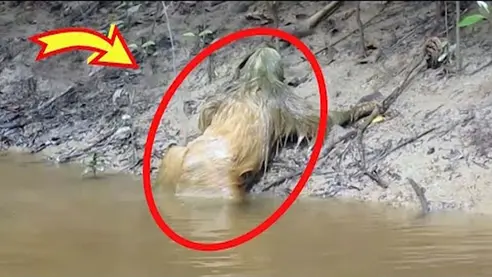
At the edge of the water, partially covered in mud and surrounded by tangled roots, a strange-looking animal appears to be emerging from the shallows. Its wet fur hangs heavily from its body, while its unusual shape makes it difficult to immediately determine what viewers are looking at.
The photograph is exactly the kind of image that can make someone stop scrolling.
At first glance, it could be mistaken for almost anything.
A strange mammal.
A creature from the wilderness.
Something injured.
Or, as some viewers might imagine, an animal that doesn’t seem to belong there at all.
The dramatic story attached to the photograph claims that a ranger saw the strange creature and contacted police.
But there is an important question hiding behind the sensational headline:
What was actually in the water?
The Strange Shape At The Water’s Edge
The photograph shows what appears to be a furry animal positioned on a muddy bank.
Its body is wet, making its fur look clumped and unusually long. The animal’s head appears to be close to the water, while its body extends upward toward the vegetation.
A large red circle draws attention to the creature.
A bright arrow points toward it.
Those markings immediately tell viewers where to look.
And once you notice the animal, it’s difficult to look away.
Something about its appearance seems completely unfamiliar.
The creature doesn’t resemble the animals most people expect to see around a typical river or pond.
That uncertainty is what gives the photograph its eerie quality.
Why Wet Animals Can Look Completely Different
One important detail can easily be overlooked: the animal is wet.
Water can dramatically change the appearance of fur.
When dry fur is fluffy, it can make an animal look much larger and rounder than its actual body shape. Once soaked, the hair can become tightly clumped together, exposing shapes and proportions that are normally hidden.
Mud can make the situation even more confusing.
An animal that would be immediately recognizable on dry land can suddenly look almost unidentifiable after spending time in water.
This is particularly true when the photograph is taken from a distance.
The viewer isn’t seeing the animal clearly.
Instead, they’re seeing a wet, partially obscured shape surrounded by mud, roots, shadows and vegetation.
Under those circumstances, the human brain naturally tries to fill in the missing details.
The First Reaction Is Often The Wrong One
Imagine being a ranger walking along a riverbank.
You notice something moving near the water.
At first, you assume it’s a familiar animal.
Then you get closer.
The shape looks strange.
You can’t immediately identify it.
For a moment, you might wonder whether the animal is injured or trapped.
That’s a much more realistic explanation for many unusual wildlife sightings than immediately assuming a previously unknown creature has appeared.
Wildlife workers routinely encounter animals in unusual situations.
Animals become stuck in mud.
They fall into water.
They become tangled in vegetation.
They can become exhausted or disoriented.
And when an animal is seen under unusual circumstances, its appearance can be surprisingly difficult to recognize.
But What Animal Could It Be?
The photograph alone isn’t sufficient to confidently identify the creature.
That’s important because several different animals can appear dramatically different depending on their environment.
A mammal with long fur can look almost unrecognizable when soaked.
An animal partially submerged in water can appear to have a completely different body shape.
And when only part of the body is visible, even experienced observers may need additional photographs or direct observation before making an identification.
That’s why a responsible wildlife investigation would normally involve getting a better view of the animal rather than relying on one distant photograph.
The original image also doesn’t provide enough verified information to establish the exact species.
Why The Ranger Story Makes The Image Even More Dramatic
The claim that a ranger contacted police adds another layer to the story.
It immediately suggests that something serious happened.
But there is a difference between a photograph showing an unusual animal and a verified account of what happened around it.
Unless the original report, ranger statement, police record, or another reliable source is available, the claim should be treated as part of the story surrounding the image rather than established fact.
That’s particularly important with viral wildlife photographs.
A dramatic caption can travel much farther than the original context.
A simple observation can become an emergency.
An unidentified animal can become a “mysterious beast.”
And a concerned call can eventually be described as a major police response.
The photograph may remain the same while the story attached to it changes.
The Water Makes The Scene Even More Mysterious
There’s another reason this photograph is so effective.
The water is calm.
Nothing immediately suggests what is happening beneath the surface.
The creature appears to be right at the boundary between land and water.
That creates an interesting visual question:
Where did it come from?
Did it enter the water and climb onto the bank?
Was it already hiding among the vegetation?
Was it searching for food?
Or was it simply trying to get out of the water?
We can’t answer those questions from the image alone.
But the uncertainty creates the suspense.
Wildlife Encounters Can Become Dangerous Quickly
Even if the animal turns out to be completely ordinary, an unusual wildlife encounter should still be treated seriously.
Wild animals don’t behave like pets.
An animal that appears frightened, exhausted or trapped may become defensive when someone approaches.
A person trying to help could accidentally make the situation worse.
That’s why trained wildlife personnel generally use appropriate equipment and maintain a safe distance when dealing with unfamiliar animals.
If an animal is genuinely injured or trapped, contacting local wildlife authorities is safer than attempting to handle it personally.
The mystery may be interesting.
The animal’s safety—and the safety of the people nearby—is more important.
Could It Be A Rare Animal?
This is where imagination can easily take over.
Whenever an unusual animal appears in a photograph, people naturally begin suggesting rare species.
Sometimes those suggestions are based on genuine similarities.
Other times, they are pure speculation.
A rare animal is still going to have recognizable biological characteristics. Experts can examine body structure, fur, limbs, head shape, movement, behavior and other features to narrow down an identification.
One blurry photograph is rarely enough to establish that something is a previously unknown species.
In fact, the more extraordinary the claim, the more evidence would be necessary.
A genuine discovery of an unknown large animal would be extraordinary scientific news and would require far more than a viral photograph.
Why Our Brains See Monsters In Strange Shapes
There’s a fascinating psychological phenomenon behind images like this.
Humans are extremely good at recognizing patterns.
Sometimes we’re too good at it.
When we see a blurry object in the shadows, our brains try to turn it into something familiar.
A tree branch becomes an animal.
A rock becomes a face.
A shadow looks like a person.
And a wet animal partially hidden beside a river can suddenly look like something completely unknown.
This tendency helps explain why mysterious wildlife photographs can produce such strong reactions.
We’re not simply looking at pixels.
We’re trying to construct a story from incomplete information.
Look Beyond The Red Circle
The red circle in the photograph makes the creature appear even more mysterious.
But try looking at the image without the markings.
The scene becomes much less dramatic.
You see a muddy riverbank.
You see vegetation and roots.
You see water.
And then you notice an unusual, partially obscured animal near the edge.
The circle tells your brain:
“Something important is here.”
The arrow tells you:
“Look at this.”
That is a common technique in viral images because it immediately directs attention toward the most ambiguous part of the photograph.
It doesn’t prove what the object is.
It simply makes sure you notice it.
The Real Mystery May Be Simpler
Perhaps the most interesting possibility is also the least dramatic.
The creature may simply be an ordinary animal caught in an extraordinary-looking moment.
It could have become soaked.
It could have been covered in mud.
It could have been partially hidden by vegetation.
And the camera may have captured it from exactly the angle needed to make identification difficult.
That’s happened countless times with wildlife photography.
A familiar animal can look completely different when seen from behind, underwater, at night, through vegetation or from an unusual distance.
Sometimes the mystery disappears as soon as someone gets a clear photograph.
What Would Solve The Mystery?
If authorities genuinely wanted to determine what the creature was, there would be several straightforward ways to investigate it.
A clear photograph would help.
Video footage would provide even more information because movement can reveal body structure and behavior.
Experienced wildlife specialists could examine the animal directly from a safe distance.
Tracks, fur, photographs and other physical evidence could potentially provide additional clues.
If necessary, genetic testing could identify biological material—but only if an appropriate sample were legitimately collected and analyzed.
That is how a mysterious sighting can move from speculation toward evidence.
One Photograph Can Create A Huge Story
The image captures only a tiny moment.
But the headline transforms that moment into a dramatic mystery:
A strange beast.
A ranger.
A police call.
And suddenly, viewers want to know what happened next.
Was the animal rescued?
Did it disappear back into the water?
Was it identified?
Did authorities discover something unexpected?
Those are reasonable questions.
But without reliable documentation of the original incident, the answers shouldn’t be invented simply to make the story more exciting.
The photograph is fascinating enough on its own.
So, What Really Emerged From The Water?
That’s the question this photograph leaves unanswered.
We can see an unusual-looking, wet animal near the edge of the water.
We can see the muddy surroundings.
We can see why someone might have found the sighting unusual.
But the photograph alone doesn’t establish that the creature was a previously unknown beast, nor does it independently verify the claim that a ranger called police.
What it does show is something far more common—and sometimes just as fascinating:
nature can make familiar animals look completely unfamiliar.
A little water, mud, distance and poor visibility can turn an ordinary wildlife encounter into an unforgettable mystery.
And until someone provides reliable evidence identifying the creature and documenting what happened that day, the strangest part of the story may simply be the photograph itself.
Because sometimes the creature isn’t mysterious at all.
It’s the picture that makes it look that way.